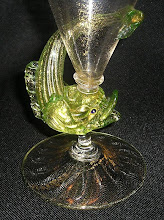
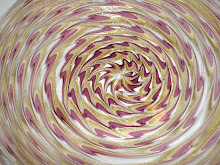
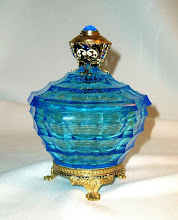
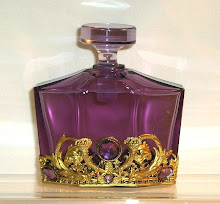
Most photos down the right column as well as those within our posts can be enlarged simply by clicking on the individual images. Those in the right column are linked to the full descriptions of the items, as well as detailed closeup photos. We hope you enjoy them!
NOTE: For more information on the items appearing in our SLIDE SHOW (just beneath the "chocolate sherbet") in the right-hand column, please contact us. Clicking on those photos will only take you to a blank page.
Thursday, January 29, 2009


Wednesday, January 21, 2009
Rare Venetian Ice Glass Vase from 19th Century Baroviers

A rare surviving piece of genuine Venetian "Ice Glass," attributed to the Barovier Furnaces of the 1890s. This magnificent spherical ice glass vase was once a lamp; the abusive hole which accommodated the lamp rod has been superbly restored by a now deceased master craftsman. The repair is so well done that it is only detectable after one has been told of it. Both the beauty and the attributed parallel history of the piece are worthy of inclusion in a museum collection.
 It measures 6.5" (16.51 cm) high, and apx. 8.5" (21.59 cm) diameter, with rim at 2.25" (5.71 cm) to the outside of the collar. Applied ruffled, crystal collar is combed and included with gold; the pair of applied crystal leaf handles are also included with gold, and there is a small amount of gold in the applied crystal foot, which is, itself, made of ten pinched and combed standing sections.
For a bit of history, we turn to Sheldon Barr's Book on Venetian Glass...in 1895,
 five years after the death of Salviati and his assigning the Salviati furnaces to the Baroviers, several rejuvenating elements "...added new dimension to the production of the Barovier Family." One of those new elements was the "...introduction of a new color to the glassmaker's repertoire, a bright blood red...." It was the same blood red of this rare and striking ice glass vase.
The method of creating ice glass was first developed in Venice in the mid-16th Century. 
In an effort to give their prized "cristallo" [see "Glass Terms According to Barclay" at the very end of our blog] the Venetian glassmakers tirelessly experimented with new methods, eventually inventing "ice glass." A new, hot gather of glass, after a brief initial shaping, would be plunged momentarily into cold water. It was then gently reheated and the the final blowing resumed, causing all of the tiny cracks in the glass to spread, weblike, and enlarge, creating the crackled, glistening appearance of frosty ice. Our sparkling Ice Glass example is circa 1895-1900.Friday, January 16, 2009
18th Century German "Forest-Green" Roemer

Following is our opinion recently given to a customer regarding art glass goblets which have been passed down through her family. The customer believed them to be Venetian, so we have touched upon that in our opinion, even though we are reasonably certain the goblets are German in origin. [click on photos to enlarge.]
"Thank you for sharing your most interesting Goblet with Barclay Galleries.
The goblets could be anywhere from the 17th Century (1600s) to the early 19th Century (1800s). However, I suggest that they are most likely early 18th Century (1700s); and of German origin. There is a possibility they were created in England, but my strongest sense is that they are German with many characteristics to substantiate that opinion.
Glasshouses in 17th Century Germany produced their "forest-green" Roemers (German drinking vessel for white wine -- the mainstay wine of Germany) in enormous quantities -- hundreds and hundreds of thousands. They became popular throughout Europe, but primarily of course, in Germany and Holland. The style was inspired not only for the white wine, but in imitation of the styles created by the Venetian glassmakers; hence they were created in "facon de Venise," or translated, "in the style of Venice." "Facon de Venise" (or "the Venetian style") spread throughout Europe, and then much later, even to the U.S., in the 19th Century.
Roemers of late 17th, early 18th Centuries had distinct characteristics, much like those in your goblet. They consisted of a Foot made of a glass thread which was spun around a wooden form, and a hollow shaft which extended to the roundish or ovoid bowl. I cannot tell from the photo if your shaft is hollow, but if it is, then the suggested date of origin is probably correct. If it is closed at the base of the bowl, then the goblets are likely not as old as I have suggested, and would be more into the early-to-mid 19th Century.
 The shaft was decorated with "raspberry prunts" (blobs of glass which were impressed with a clay form to make the "raspberries"). In addition to this prunt being decorative, it was originally designed for providing the drinker with a better grip, as forks in the 17th Century were not commonly in use, and hands at the dining table (or pub) were usually greasy. These early German designs also displayed the ribbed glass thread visually separating the bowl from the shaft, as in your goblet. It appears in the photo, almost as if a row of glass beading above the prunts.
These goblets, were the most popular type of the "forest-green" drinking vessels, and the most well known of those vessels, during the 17th Century. By the 18th Century, they were declining in popularity.
Roemers in this day are no longer popular for use, but there will always be collectors of antique glass who will find them of interest for their collections.
It's been a pleasure -- and I hope this is helpful to you, and that you continue to enjoy your lovely goblets. They are a fine treasure."
It's been a pleasure -- and I hope this is helpful to you, and that you continue to enjoy your lovely goblets. They are a fine treasure."
Wednesday, January 17, 2007
ILLUSTRATED LONDON NEWS, 1850, EXHIBITION OF ANCIENT AND MEDIEVAL ART
 "Groupe of Venetian Glass."
The above engraving is from The Illustrated London News, March 30, 1850, page 217. Following is the brief description of this glass in the article: "The groupe (sic) of Venetian glass below [above on our page] has been formed from specimens contributed by the Duke of Buccleugh, Mr. Farrer, and Mr. Slade. We observed in our former notice of this Exhibition how famous Venice had become in the middle of the fifteenth century for its manufacture of ornamental glass, and more appropriate of the different processes in vogue could scarcely have been selected by our artists, either for beauty of form or design. [click on photo to enlarge]
Exquisite, Sooooo Venetian Scent Bottle

Nineteenth Century beauty, in this lovely 5-inch scent bottle. The color is deep, "yellow ochre" from the artist's color palette, transparent, and with tiny, included flecks of gold throughout the entire piece. Wonderfully ribbed in a pattern which begins at the center base, flaring, and then narrowing again, at the neck of the bottle. The bulbous body is captioned by a foot of ochre roping, also included with gold. The tightly ribbed, double-turban stopper is intricately hand-tooled with textured petals all around; tiny attached prunts, appearing as "jewels of amber," encircle the largest turban; and it is topped with a large, attached ochre bead of glass at the crown.
Perfumes of less ornate and intricate styles are more common, while pieces of this type are considered scarce and desirable.  Often the bottle, itself, may be found, although the original stopper may be missing. Be certain, also, to check the dauber of the stopper which should reach well past the center mark of the body, and often completely to the inside base. Dating is from the Mid-to-Late 19th Century, undoubtedly by one of the finest glass houses of Murano, Italy. www.barclayart.com

Sunday, January 14, 2007
ILLUSTRATED LONDON NEWS, 1866, On Salviati & Venetian Glass
 "SPECIMENS OF THE REVIVED ART OF VENETIAN GLASS-BLOWING"
 [click on photo to enlarge]
Following is the verbatim, partial transcript of the actual article which appeared on December 15, 1866, in THE ILLUSTRATED LONDON NEWS. The portion which we have begins on page 585, although the original beginning and that portion which would complete this article, began on page 584. Mentioned are places of note, in London, where examples of Dr. Salviati's glass mosaics may be seen, presumably today, also. The original address of his London showrooms is also offered. Very interesting historical information is within this article for the serious collector and student of glass. The article reads:
"....an intelligent and experienced artisan of Murano, who had, some years before gained some public notice of his exhibitions of the enameling process. Dr. Salviati, having carefully studied the whole subject, and being a man of science as well as of taste, succeeded in the invention of a new method of mosaic manufacturer, the results of which already are to be seen in England in several fine examples, such as the large picture of Isaiah and the Angels beneath the dome of St. Paul's Cathedral, the vaulted roof and other parts of Cardinal Wolsey's Chapel in Windsor Castle, that prepared for the canopy of the Prince Consort National Memorial in Hyde Park, the cross over the chancel arch of All Saints' Church at Windsor, and a lifesize figure in the South Kensington Museum, besides important works in hand for Westminster Abbey. Dr. Salviati next turned his attention to the blown-glass manufacturer, which is practised in its greatest perfection at Murano, a small island of the Lagoons, near Venice. A minute description of the works at this place was given by the special correspondent of the Times in a letter published on the 19th of last October. The tools used are few and simple, being only the furnace, a hollow reed or tube of iron, a few pairs of shears and cutting instruments, and stamps and dies. The end of the reed is dipped into molten glass; a portion is thus taken up and rolled on the table, after which the blower, with his own breath through the tube, converts it into a hollow ball, and it is shaped by hand, with repeated manipulations, into a drinking-glass, a cup, a jug, a vase, a bowl, a decanter, a chandelier, or whatever else may be designed. The variety of ornamentation, as by filigree-work, interlacing opaque with transparent glass, by intermixture of gold, ruby, green, purple, and other colours, or by moulding and twisting the stems and edges, of which this manufacture is capable, may be witnessed in a visit to Dr. Salviati's London depot, 431, Oxford-street. A few specimens are represented in our Engraving [above] which shows at least the graceful designs of modern Venetian glass."
Saturday, January 13, 2007
Francesco Ferro & Figlio, Rare Vase, Semi-Precious Stones
Looking as if it were only just excavated from an ancient spa, shaped to perfection, with a trumpet neck, outstanding side handles, gourd-shaped body, and large ball-knop stem. A very rare piece of glass attributed to Francesco Ferro & Figlio, Murano, Italy, created in opaque glass in imitation of semi-precious stones......


there are murrhine bits which resemble coral, carnelian, and varying shades of onyx and turquoise. Also glistening brightly, is a large amount of included, real, copper Aventurine which is distributed throughout the piece.


The photo of the foot reveals a quite generous fold on the underside, as well as the remnants of the original pontil scar. Height of this piece is just over 9 inches, with the largest diameter being 4 inches, and for reference, the foot is 2 and three-quarter inches in diameter.


Other similar glass of the 19th Century, although more swirled and less defined "stones," was glass referred to as "agate," "schmelze," and "opal glass," or "opaline (in solid colors without murrhine pieces)," all in elegant and beautifully successful attempts to imitate natural stone. The circa date of this wonderful Venetian glass vase, is 1880. [click on photos to enlarge]
Friday, January 12, 2007
Red Vase, Venetian Glass with Dolphins. Salviati or Venini?

This is a gorgeous vase we placed a few years ago. "Red Vase" is an understatement, as this wonderful piece IS a statement all by itself. It speaks drama, in that its size is impressive at 11 inches tall, and 6 inches at the widest diameter. It speaks sophistication, in that its shape is smooth, classic, and definitely holds the eye. It speaks color in a most attractive, vivid blood-red, calling attention to itself that one cannot deny.
The attached dolphin pair adorns the sides, and appears as "handles" on either side, just under the graceful, 5-inch flared, open mouth. Each sentinel creature was created of clear crystal glass, richly included with real gold. It has the tell-tale sharp, snapped pontil from the blower's gather, and the folded edge encircling the foot. The texture which appears in the photo, is from shadow-ribbing within the interior, causing the entire piece to emit wonderful optical sensations. 
 As with all 19th Century and early 20th Century Italian glass, this vase is not signed. The "feel" of the piece is Salviati, with a circa date of 1890-1900. We should point out there are quite similar pieces which were believed to have been created by Venini in the early 20th Century, in the 1930s. Was Venini imitating Salviati? Or is it possible this actually was a 1930s Venini vase? We can only suggest the possibilities, and leave any
 definite answer until a later time. Whether it was by Salviati or Venini, it is an exquisite Venetian Glass creation! [click on photos to enlarge]

 As with all 19th Century and early 20th Century Italian glass, this vase is not signed. The "feel" of the piece is Salviati, with a circa date of 1890-1900. We should point out there are quite similar pieces which were believed to have been created by Venini in the early 20th Century, in the 1930s. Was Venini imitating Salviati? Or is it possible this actually was a 1930s Venini vase? We can only suggest the possibilities, and leave any
 definite answer until a later time. Whether it was by Salviati or Venini, it is an exquisite Venetian Glass creation! [click on photos to enlarge]
Thursday, January 11, 2007
WELCOME......to the

Barclay Glass Gallery
from Barclay Galleries
The dragons on the left, are from our personal glass collection, a 19th Century, Venetian Glass candelabra from the furnaces of Salviati Dott. Antonio, The Venice and Murano Glass Company Limited (Salviati & C.), with a circa date of 1890-1900 (possibly earlier). This piece which we use as our logo, has a very interesting history, which you can read in its entirety, as well as view additional photos of the dragons, on our website, www.barclayart.com, and by placing the word, "dragon" in the search box on the first page of our catalog.
It's our intention to create this site for the benefit, information, and pleasure of those who have an interest in art glass, in general. However, because the author's favorite art glass is Venetian, there will often be examples of this type of glass, and lots of "Venetian glass" discussion.
We hope to keep this fairly casual, so there's no particular order in which you will find information here. Nor will posts be made on a regular basis, rather as time permits. So please check the site often for new information, photos, and discussion. The whole format may even take on a different shape. Whatever the future of the site, we're looking forward to it.
Subscribe to:
Posts (Atom)